Thelema Lodge
Ordo Templi Orientis
P.O.Box 2303
Berkeley, CA 94702 USA
July 1996 e.v. at Thelema Lodge
Announcements from
Lodge Members and Officers
Officiation in the mass in the roles of Priestess, Priest, and Deacon has
been restricted by our Patriarch during the past few years to initiates of the
I° O.T.O. and above. This unfortunate and unexplained ruling has met with
compliance here only under continual protest from the membership. The
prohibition of occasional exceptions to this criterion has prevented the
offering of a few very fine masses, as well as -- on a few occasions -- loading
a burden onto our usual pool of officers when vacations and personal
circumstances reduce it below a comfortable level. Some slight frustrations
experienced a decade ago in teaching Liber XV to a group of Thelemic
"outsiders" never represented a threat to the integrity of our performance
tradition at Horus Temple, and similar concerns have not arisen since then.
On the other hand, we lose opportunities of strengthening this vital tradition
by the arbitrary exclusion of guest officers who evince natural ability, and
we also risk compromising the efficacy of the I° initiation when it is
requested prematurely for the sole purpose of satisfying the restriction. The
members of Thelema Lodge, who have sustained the E. G. C. with the celebration
of nearly a thousand Gnostic masses here over the past two decades, believe it
is high time for a review of this needless policy.
"The following is a short analysis of the series. They may be taken as illustrating Humanity -- its fate, both good and evil.
"Man, unable to solve the Riddle of Existence, takes counsel of Saturn, extreme old age. Such answer as he can get is the one word 'Despair.'
"Is there more hope in the dignity and wisdom of Jupiter? No; for the noble senior lacks the vigour of Mars the Warrior. Counsel is in vain without determination to carry it out.
"Mars, invoked, is indeed capable of victory, but he has already lost the controlled wisdom of age; in the moment of conquest he wastes the fruits of it, in the arms of luxury.
"It is through this weakness that the perfected man, the Sun, is of dual nature, and his evil twin slays him in his glory. So the triumphant Lord of Heaven, the beloved of Apollo and the Muses, is brought down into the dust, and who shall mourn him but his Mother Nature, Venus, the lady of love and sorrow? Well is it if she bears within her the Secret of Resurrection!
"But even Venus owes all her charms to the swift messenger of the Gods, Mercury, the joyous and ambiguous boy, whose tricks first scandalize and then delight Olympus.
"But Mercury, too, is found wanting. Not in him alone is the secret cure for all the woe of the human race. Swift as ever he passes, and gives place to the youngest of the Gods, to the Virginal Moon.
"Behold her, Madonna-like, throned and crowned, veiled, silent, awaiting the promise of the future. She is Isis and Mary, Istar and Bhavani, Artemis and Diana.
"But Artemis is still barren of hope until the spirit of the Infinite All, great Pan, tears asunder the veil and displays the hope of humanity, the Crowned Child of the Future."
-- excerpted from Aleister Crowley's prospectus advertising The Rites of Eleusis, distributed late in 1910 e.v., as reprinted in The Magical Link 5:2 (New York: O.T.O., summer 1991).
 M M
M M
Active initiates of the III° and above in O.T.O. are invited to a meeting
in Horus Temple on Saturday evening 13th June at 7:30. Brother Jim Graeb, a
past master of Thelema Lodge and an initiator of long experience, will lead a
discussion of the work of the Blue Lodge (the first three degrees in the
initiatory system patterned upon freemasonry), which will open out into
contemplation of the Royal Arch of the IV°. Third degree members considering
further advancement in the coming year should attend (or send word if they are
unable to be present).
The Court Cards will be the focus of the fourth meeting in Bill Heidrick's series on Tarot this month, continuing our exploration of the three parts of the deck. Join this illustrated lecture and discussion, which meets in Bill's home at 5 Suffield Avenue in San Anselmo at 7:30 Wednesday evening, 24th July. In addition to the color slides which accompany the discourse, there will be dozens of variant editions of the Tarot on display, from facsimiles of the earliest Renaissance Italian cards to idiosyncratic modern versions designed to accommodate various traditions of divination and iconography. Example readings from the cards will be offered to demonstrate a variety of styles, layouts, and interpretative strategies for presenting their meaning in response to specific questions and issues. Additional information and directions may be obtained by calling Bill ahead of time at (415) 454-5176.
The John Dee reading group with Clay Holden meets in the library at Thelema Lodge on Saturday evening 27th July at 7:00 to continue our reading of Liber Mysteriorum Tertius. The four "spiritual actions" which Dee transcribed into this diary were conducted with his assistant Edward Kelly over the course of one week in the middle of spring in the year 1582. After the seven tables of heptarchy have been painstakingly copied out of the crystal "shewstone," the 49 names derived from them are listed and analyzed.
Grace's workshop series on "The Houses of Astrology" meets on Friday evening 26th July at her house in Berkeley, from 7:00 to 9:00. Our focus this month will be on the Second House. In a chart, the Second House shows the personal worth of the native, or material worth of the entity, for which the chart was drawn. It indicates personal security, assets, movable possessions, bank accounts, and such things as diplomas, certificates, or other acknowledgements of skills which improve earning potential. Grace's workshops are open to all students, and the interests of all levels of astrological competence can be accommodated. This is, however, not a "drop-in" event, and all who plan to attend should please phone ahead at (510) 843-STAR to let Grace know.
Participants are welcome at the Scrying workshop being offered by the Enochian Liturgy Group on Saturday evening 20th July at 8:00. This group meets in Horus Temple, and information may be obtained by calling Michael Sanborn at (510) 601-9393.
The Thelema Lodge "luncheon meeting" is scheduled this month for Sunday afternoon 14th July, from 12:30 to 2:30. Library Nights have been reserved on the calendar for Tuesday evening 9th July and Thursday evening 18th July, from 8:00 to 10:00. To attend these events, contact the lodge by phone ahead of time, or otherwise communicate your intentions to one of the lodge officers.
by Aleister Crowley
It is a generally recognized fact that the onlooker sees most of the game.
The rulers of a country make most of their mistakes because the knowledge of
detail which is constantly thrust upon them is so great that it binds them to
fundamental considerations. The emergencies of the moment lure them into
bypaths in which they become lost. Those ancient governors who, despairing of
their own judgment, consulted the oracles, were truly wise. England never
made so serious a mistake as when she failed to utilize the brain of Carlyle.
The tendency of all men who are immersed in affairs, whether public or
private, is to become concentrated upon tactical problems, and in so doing
this they lose sight of the principles of strategy. The real ruler or adviser
of a nation should be a man entirely free from the expediencies of the passing
day. The mischief wrought by failure to understand these facts is
particularly obvious in finance. Politics, in some countries at least, is
still looked after by men of broad general education; but finance is entirely
in the hands of experts. Its terminology has been deliberately complicated;
partly, no doubt, as in the case of law, with the idea of making it easier to
hoodwink the layman; but the so-called experts themselves have become totally
oblivious of the fundamental principles of their own business. Even worse,
they have become ensnared by the greatest of all possible delusions; not only
are they ignorant of the truth, but they believe most firmly its exact
opposite. Money appears to them the only thing of value, whereas in reality
it has no value whatever. It is merely a convenient medium of exchange of
commodities which have value. If it were not for this, the present system
could never have been created. As things are, a piece of paper is just as
good as a piece of gold; but, as everyone knows, even the financiers, ninety
five per cent of the gold never existed. The possibility of calling for gold
has so frightened those very people who have been screaming for years that
gold was the only basis, that already there has been a threat to demonetize
gold. This is no vain threat. It is quite possible and will almost certainly
be necessary; though probably the process will be carried out by some trick
which will conceal the fact from the people. But you cannot demonetize wheat,
or coal, or copper, and any one who possesses these things can call for
anything he likes in payment for them, and be sure of getting it. But the
financiers of the day avoid all consideration of the enormous calamity
threatened by the present situation. They are only excited by perfectly
trivial and temporary events, such as small movements in the value of stocks.
It never occurs to them that the most trifling shifts in the real economic
situation may reduce the value of stocks to nothing a tall. The history of
finance has always been the history of more or less desperate efforts to hide
these facts. And the drastic expedients adopted at the beginning of the war
shew clearly enough in what delicate scales the business of the world is
weighed.
Now, whenever a crisis occurs in the affairs of the world, it is imperative
that they should be examined de novo by a mind which has never lost sight of
fundamentals. The expert becomes useless at such times for the very reason
that he is an expert. Temporary expedients will not serve. As a matter of
fact, this is always more or less subconsciously recognized by the good sense
of the people. The hopes which were excited by the election of Mr Wilson to
the presidency were based entirely on the fact that he was not a professional
politician. In the same way, in England, to take a recent example, Edward VII
was trusted and respected by the people principally because he had won the
Derby. The instinct of democracy is always sound; its mistakes are due to
that instinct being overlaid by the partial development of its intellect,
which too often leads it wrong. But in moments of calm it invariably
distrusts the appeals which are made to its cupidity of its cowardice; and it
much prefers its affairs to be in the hands of ordinary, sensible men of the
world. The political tragedy of England today is largely due to the replacing
of the good, old-fashioned, honest statesmen, like Lord Salisbury (stupid as
he was) by clever and ambitious nobodies like Rufus Isaacs and Lloyd George.
It seems just possible that the present catastrophe which has overwhelmed
Europe and threatens to engulf civilization entire may arouse the deepest
instincts of the people, and cause them to appeal to the only types of men who
can save them -- the Prophet and the Poet. America has no Poet, and may be
counted exceedingly fortunate in possessing a Prophet of the first class:
Mr Henry Clifford Stuart.
Imagine to yourself a big man, a really big man, six foot three in height,
broad and well-proportioned. The entire impression is of bigness. And as
should always be the case with homo sapiens, the most important part if the
impression is given by the head. Such a brow is only seen in the world's
greatest thinkers.
Mr Stuart was born in 1864 in Brooklyn, N.Y. His father, John Stuart, was
a Captain of the 51st and Lieutenant Colonel of the 63rd New York Volunteers.
His is the perfect and ideal type, fast disappearing, of the aristocratic
American. Mr Stuart was educated in San Francisco, California; but it is one
of his favorite claims that he is not educated. Rather, he would say, he is
beginning to educate himself. And this is one of the secrets of his immense
power of brain. By education in the ordinary sense we mean that an old fool
bullies a young fool into agreeing with him. In order to obtain a university
degree it is necessary to stultify oneself by agreeing with the particular
clique of fifth rate minds who, having been totally unable to carve out any
way in the world, have become sodden in the backwater of a university; and
taken up teaching as a profession, because they are incapable of learning.
One has only to think of a subject like history to see how lop-sided
conventional education always is. Even in more truly scientific subjects
there is the same parochialism. Consider Sir William Hamilton and his
doctrine of the quantification of the predicate, which everybody in
Edinborough in his time had to accept, or fail in the examination, but which
every other school in Europe regarded as nonsense. Such training can only
serve to unbalance and destroy the mind. Mr Stuart avoided this tragedy.
Instead, he read everything, kept his eyes open, and never allowed the
specious arguments of the logician to lure him into conclusions opposed to
common sense. Almost every writer falls into some trap. Either he omits a
premise, or takes a false one, or commits some logical error unperceived. But
with such skill does he execute his sophistry, and so deeply does his vanity
flatter him, that even the most careful revision fails to discover the error.
Consequently, humanity is always the prey of deceptions. Think for example of
the arguments in favor of vegetarianism. It is impossible to refute them. At
the same time they are totally invalid, because they neglect one single,
small, but all-important fact: "Man is a carnivorous animal." The calibre of
Mr Stuart's mind is such that he is incapable of being of hoodwinked by any
mere arguments, however clever, cogent, and convincing. He invariably applies
the standard of truth, intuitive or instinctive, to the conclusion. And if there be a contradiction, he perceives it instantly. A brain of this kind is
peculiarly useful in America, where the people are the slaves of false logic.
In transplanting themselves from their native soil, they have left behind them
their greatest possession: inherited race knowledge. I have never yet met a
stupid American. But Mr Stuart is almost the only one whom I have met who was
not silly. No people are so quick to perceive the meaning of what is said, or
so eager to listen to what may be said, but they judge entirely by what is
said: they have no standard of atavistic experience to tell them whether it is
right or wrong. The most ignorant peasant in Europe, who firmly believes in
ghosts and vampires and werewolves, who cannot read or write, has never
travelled beyond the radius of twenty miles from his hamlet, and knows nothing
of his country's affairs, much less of the world's, could never be so
insensible to the facts of human nature as Henry Ford. You could argue with
him "til all was blue," but you would never even begin to persuade him. He
would know it was all nonsense, just in the same way as you cannot fool a dog
about a tramp. It is true that this instinct is sometimes wrong after all in
certain minor matters, because now and then conditions do change. But in all
fundamental points humanity has not altered since the cave man. A friend of
mine was arguing the other day about this very matter. "Nowadays," said his
opponent, "if you want a girl, you cannot `twist your knuckles in her hair,
Club her, and drag her bleeding to your cave." "No," said my friend, "things
have changed a great deal since the eighth of July!"
It is just this capacity for seeing everything sub specie aeternatitis
which distinguishes the great artist or the great seer, even to a certain
extent the great statesman, from plausible imitations. We do not value
Shakespeare's histories for their political views; in fact, the portrait of
Joan of Arc is a stain upon the character of the poet which no ages can
efface. (But the English always blackguard gallant enemies.) The merit of
the histories lies almost entirely in the character of Falstaff, who has
nothing to do with the period. And the political errors of Shakespeare show
how difficult it is, even for one who has the vision of the eternal, to keep
straight when he comes to deal with the temporal. But the explanation is that
Shakespeare was a snob, the lackey of debauched noblemen, without virility or
independence of character. Courage is certainly the first of the virtues, for
without it none of the others can be exercised. In the case of statesmen a
little more latitude must be allowed, because they are compelled to deal with
the conditions of the moment. But, even there, the best epithet that can be
applied in praise of such a man is that he is far-sighted; and the way to be
far-seeing is to refuse to be obsessed by the expediencies of the hour. And
while it is of course impossible to make every particular conform to the
general, it can at least be arranged that it should not be in flagrant
contradiction to the first principles.
As a concrete example, the annexation of conquered countries. Economic or
military reasons have often been allowed to over-ride considerations of the
will of the inhabitants. Such acts have almost invariable cause trouble later
on, and such trouble frequently extends far beyond the territory in dispute.
The injury to the fingertip poisons the whole body. The Germans in 1870, when
asked whom they were fighting, replied: "Louis XIV." And it was because that
monarch tried to extend his dominions that they, at this present moment of
writing, are invaded. The need of an independent mind in dealing with all
such matters is evident. Not only must the statesman be a philosopher, but he
should also have in his composition not a little of the mystic. We do not use
the word mystic in the specialized sense, in which it is too often employed
today. The true mystic is one who sees all phenomena without bias, prejudice,
self-interest, or obfuscation. In thinking of kingdoms, he thinks of
spiritual kingdoms; and here again we must use the word spiritual in its
oldest and widest sense. In such kingdoms faith is more than frontiers,
language and literature more than markets. Ireland has been systematically
depopulated; every engine of oppression has been set in motion against her;
but she has never been conquered and never can be conquered, because the Anglo-Saxon can never get her point of view. In the same way India has
overcome every one of her invaders in turn, though she has never been able to
resist even the least of them successfully by arms. The English in India have
become, within two generations, more Indian than the Indians themselves, in
many important respects, particularly in that of caste. In the case of South
Africa it is once again evident how far more vital than material
considerations are the spiritual. The Boers, driven from one settlement to
another by the most barefaced treachery and tyranny, and finally conquered in
their last stronghold by invading armies outnumbering them twenty to one, were
yet able to reconquer their country for themselves, without a drop of
bloodshed, within a decade of the fall of Pretoria.
But in order to perceive the rights and wrongs of all such matters
independence of mind is just as necessary as clearness of vision. When the
man can be influenced by considerations of his own welfare, when hope and fear
find any place in his mind, he is no longer to be trusted. The only man who
can fulfil this condition is the prophet. (It must be remembered that the
functions of poet and prophet were originally identical. The distinction
between them is the artificial one of form. The states of mind are
identical.) A true prophet lives only by virtue of his inner vision. He is
responsible to what he calls God, and to nothing and nobody else. Such men
are rare, as are all other types of genius. And it is the innate perception
of this fact that causes the people to look for prophets always, but most
especially in times of crisis. For this reason also false prophets abound.
It is only natural that the valuable should be counterfeited. But the test of
the true prophet is a very simple one. It is the independence of his mind.
False prophets are venal, time-servers, flatterers. They make it a rule to
say what other people wish to hear. They have no grasp of fundamentals, of
essentials, of the spiritual truths that lie beneath the accidental and
temporary phenomena which obsess other minds. They are also characterized by
simplicity. There is no sophistication in their intellect. When they add up
two and two it always makes four.
Even when you have your true prophet, however, it is commonly found that
there are difficulties in using him. Firstly, his uncompromising directness,
and the fierce quality in him, need tempering with tact; or seem to do so.
Secondly, his utterances are often obscure, or seem to be obscure. They are
not really so. But where a thoroughly sophisticated mind, nursed on false
premises and schooled in sophistries, receives the impact of the prophetic
intelligence, it is bewildered by the simplicity of that intelligence. One is
reminded of the story of charlatans who proposed to weave for the emperor a
robe which should be visible only to the innocent. They made no robe at all.
But the emperor and all his ministers had to pretend that they saw one; and
the fraud passed undetected until a child in the street cried out: "But the
King is naked!" Nowadays, however, people are not so easily undeceived. The
child would very likely not be understood. The word "naked" is not in the
vocabulary of the fashionable dressmaker; besides which, the word is improper.
We know that there are no such things! So that even if a dawning perception
of the meaning of the prophet strikes the more enlightened minds, it is often
put aside with a sort of horror; although that word has been awaited with
yearning and anxiety.
Now it must be confessed that this objection does to some extent apply to
the writings which we have under consideration. Mr Stuart's style is as
difficult as Wagner's or Whistler's were to their contemporaries. We have
acquiesced so long in the false meanings which have been placed upon the
simplest words by those whose interest it is to deceive us, that when those
words are used in their proper, simple sense, we hardly recognize them. For
this reason we have deemed it necessary to comment in various places upon
these letters. It is also to be remarked how curious a form Mr Stuart has
chosen for the expression of his thoughts. It is simple, attractive, and
convenient, and possesses the great advantage that his messages are
automatically dated.
Derived from a lecture series in 1977 e.v. by Bill Heidrick
Copyright © Bill Heidrick
In this part of the series, we will be dealing with things in Qabalah that
are especially connected to Netzach, number 7 on the Tree. Within that wider
field, the focus will be upon an examination of each of the 10 Sephirot for
problems or difficulties that may arise. There is a lot of talk about the
negative Tree or the opposite Tree, but most of this is either oversimplified,
personified excessively or exaggerated. We will look at each of the 10
Sephirot to see what kinds of things are awkward in those states of
consciousness. This is particularly applicable to Netzach, since Netzach is
the most unstable of the lower Sephirot. It almost invariably starts to
backslide as soon as you've got a grip on it, since it possesses the quality
of the Illusion of Success.
Malkut is one of the four Sephirot that traditional Qabalah sees as
possessing a Qlipot. A Qlipot is a shell -- a thing that contains force,
consciousness or life energy in dysfunctional fashion. There are other
shells, but these four: Netzach, Hod, Yesod and Malkut have major problems.
The other Sephirot occasionally show problems, but those are generally derived
from a flaw, restriction or lack of development in the bottom four Sephirot.
The Qlipot for Malkut is just plain physical weakness or the inadequacy of
one's physical forces --- if you run out of money that's the shell or Qlipot of
Malkut. If you feel tired, sick or the world around you is not providing
everything you need that is a fundamental problem of Malkut. Such a problem
in Malkut will also show up elsewhere on the Tree, but physical weakness or
inadequacy means the root of the difficulty is in Malkut. Hod may be involved
because of rigid planning and refusal to adjust to limiting conditions. Yesod
may divert the mind with daydreams or illusions when the body is tired. The
other Sephirot may follow, each contributing an added encumbrance on an
inadequate foundation. Malkut is the template for both beneficial qualities
and defects in the other Sephirot, when the Tree is viewed as a model for
attainment or assessment of human mental states.
The path of Taw coming out of Malkut and up to Yesod is in a sense the
whole Tree. You can string a miniature Tree of ideas from Malkut to Yesod,
and it is as though that's the seed from which the rest of the Tree grows.
Any defect on the Tree will show up in Malkut as a flaw in resources and in
Taw as a deficiency in effort. All things that are made permanent are made
permanent in Malkut, the physical world; and any flaw in the Tree will
inevitably appear there.
It is the nature of Malkut that material things are often uncontrolled and
may surpass human endurance. Deal with this shell by recognizing that it is
there. It cannot be completely conquered, for there will always be some flaw,
some limitation on the physical plane. It is necessary to accept this as an
unavoidable condition, to be anticipated where possible and to be considered
part and parcel with incarnation. There is an art to discovering when and
where you are strong and sensitizing yourself in those moments of strength
with the foreknowledge of inevitable moments of weakness. That is the way of
avoiding entrapment in the shell of Malkut.
The Qliphot of Yesod is a limitation in the ability to imagine or
fantasize. A person may experience hesitation, a simple break in the sense of
the flow of things. This can happen if someone is talking to you and suddenly says something that bothers or distracts you. Yesod's flaw is not as serious
as that of Malkut, since experience in life enables one to limit its effect or
at least diminish it. You can control the extent to which you are startled
out of a comfortable place. Meditation is often assailed by this kind of
problem since meditation takes the form of a flowing reverie and usually
starts as a controlled fantasy. Mantra can ride over these flickerings of the
mind. Fear in the form of panic can interfere in Yesod especially by causing
one to loose interest or to divert attention completely from an imagining or a
fantasy. Some forms of Magick plan around the Qlipot of Yesod, deliberately
inducing startlement for the sake of ritual effect. In such an application
it's not a flaw, but a release, an opening and a sudden flow of power. The
true Qlipot of Yesod is a loss, a complete break of mood or imagination. Such
a break can turn a fantasy away, weaken a meditation and cut off an
inspiration.
Hod is a place of practical intelligence, and the Qlipot of Hod often takes
the form of excessive mental rigidity. Hod tries to rule too strictly by
covering every possible thing, trying to use more mental control than is
possible. The shell of Hod is simply the limitation of the rational mind.
There are times when you just can't manage to be that complete. Even if you
could, by healing every wound, repairing every damage, and eliminating
everything that doesn't fit, you might destroy the very gates through which
you may continue to grow -- like someone plastering all the doors and windows
of a building.
The flaws of the Sepherot are of two kinds, not enough and too much. This
is true of all of them, but especially of Hod, Netzach, Yesod and Malkut.
Inadequacy is obvious but excess is often overlooked because it seems like
virtue. Except for Temperance, any virtue carried to excess is vice; and the
only way Temperance can escape the failing is by applying Temperance to
Temperance. All the Sephirot can be seen to have such potential flaws, either
something is not strong enough to produce that Sephera in its proper form or
it manifests too strongly and breaks the balance of the Tree.
Each Sephira will have unique variations on excess and insufficiency, often
combined. In Hod one may try to do something that is not ready or suited to
be done. The classical example is trying to put a square peg in a round hole.
Only frustration or breakage can result from that. It is common at such times
to experience a weakening of the imagination and a physical lethargy, as the
Qlipot of Hod cascades down to those of Yesod and Malkut. Being too much in
the rational mind will lead to loneliness. This pain is typically seen in one
who has been obsessive in Hod. There is a feeling that all these great
mysteries and practical ideas are there, that you have a touch of them but
cannot communicate them. Other people are not interested. The world does not
respond to what you see as great in the world. From that feeling of misery
and loneliness there may come a sense that change and further growth is needed
in a new direction. The Qliphoth of Hod has that little bit of an opening in
it. Such a realization may lead you to distrust the rigidity of the rational
mind and rise in due course to Netzach.
The Qlipot of Netzach is called Nogah or shining splendor. This is the
last of the difficult flaws in the Sephirot -- the sense of things being
perfect, being alright so you can cease to apply effort. Usually the first
encounter with Netzach is one of joy, release and delight, especially when it
is experienced after the dryness and loneliness of Hod. The moment one breaks
through is the moment that one must work the hardest, to maintain, improve and
go beyond the Illusion of Success. A example: suppose someone who enjoys
music started dreaming; "what if I get together a band, write the songs and
play these things? I could be famous!" If that spills over into imagination
too completely, the pleasure of the accomplishment would be briefly
experienced, but no work to create the band would be done. That's the problem
of Netzach. Although it's less severe than the Qlipot we have already
examined, it is more tricky. To conquer this flaw is simple. Keep on doing
the same things which led up to the start of success. This is like a brushing with enlightenment, not partial enlightenment since this can be utterly lost.
With Tipharet you can have partial enlightenment, something that will leave a
trace and be attainable again with less difficulty -- not with Netzach. Over-
reaching is also possible in Netzach; and this is the place of Hubris, the
fault of overweening pride. You can run into trouble with Netzach by either
slacking off at the wrong time or pushing too much based on misplaced faith in
ability. When things seem to be going great, one may disregard the usual ways
of dealing with people, places and oneself. At that point you skip Hod, you
skip Yesod and you break in Malkut. Lack of known precautions also hits hard
in Netzach, from not bothering to note where you parked a car to getting so
far out to sea in a small boat that you can't find the land. Instead of a
fall straight down from Netzach into Malkut this would be a fall directly down
into Yesod. That's the fantasy breaking underneath Netzach.
The secret to Netzach is that which brings it through --- the quality of
endurance.
| Deeper by far | |
| Than any star | |
| Deeper than the Unknown Night | |
| The spaceworm spins its prison bar | |
| Its casement tower, height on height | |
| "Shell by the Abyssal Crustacea" | |
| Alien Star | |
| Alien Light | |
| Shine upon our Alien Fright | |
| Alien Sun | |
| Alien Star | |
| Shine upon our Prison Bar | |
| The nematodes | |
| In their abodes | |
| Renew the categories | |
| The scaly reptile in the roads | |
| Seeks on Her Lunar glories | |
| "Shell by the Abyssal Crustacea" | |
| Alien Star | |
| Alien Light | |
| Shine upon our Alien Fright | |
| Alien Sun | |
| Alien Star | |
| Shine upon our Prison Bar | |
This is one of Grady's best-known poems, and was originally published in The O.T.O. Newsletter 1:2 (Berkeley: December 1977), then in The Magickal Link
3:10 (Berkeley: October 1983), and The Bystander 1:3 (Berkeley: Ankh-af-na-Khonsu Lodge, O.T.O., September 1986), as well as the volume of Grady McMurtry
Poems (London, UK & Bergen, Norway: O.T.O., 1986), before being collected in
The Grady Project 4 (Berkeley: Thelema Lodge, December 1988), and lately also
in The Red Flame 1 (Oakland: Pangenator Lodge, 1995).
In the cycle The Angel and the Abyss, this poem corresponds to the Moon trump,
Atu XVIII, and Grady regarded it as a breakthrough in his own poetic
development. With this utterance, he "went into a different dimension" as a
poet. The cycle, he recalled, "began with perfectly ordinary poetry . . . .
And then, sure enough, right there in the middle, was the 'break' the Magician
is always looking for in any Magical Experiment, that point where you go 'from
one universe to another,' as the poet says, or where you 'take a little leap,'
as Einstein put it." (from Grady's essay "On the Thelemic Vibration" in The Magickal Link (Berkeley: O.T.O., October 1983).
| P.O.Box 2411, Hollywood, Calif. | March 27, 1943. | |
|
Dear Karl,
{signed} Max {Schneider} P.S. A.C.'s long awaited letter finally arrived; over a month via airmail! -- With it a very interesting six page article on food. -- I am passing it along to Roy who phoned last night from Altadena; he had come in to buy more calves; has now 26 of them. He seemed in very good spirits and may visit me next week-end. -- Let me know if you want to use the article and I shall ask Roy to send it to you.
| ||
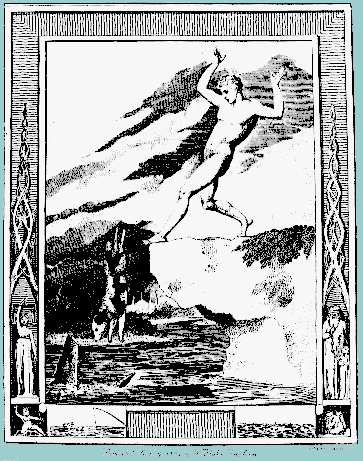
(Originally published as an illustration of William Hayky's The Dog, plate 396. Reproduced here with thanks to David McIrvine, who kindly provided the Editor with a photocopy)
For additional examples of Blake's use of Tarot in his art, consider his
Illustrations to the Book of Job. Counting the title page (which is not
numbered and has a large Aleph in the spelling of "Job", there are 22
illustrations. Each is numbered, from 1 to 21. Several have a suggestive
quality about them, which evokes Tarot a bit. Two are far from merely
suggestive. No. 15 shows Leviathan and Behemoth --- reasonably appropriate for
the Devil Trump. No. 16 shows two figures falling in flames upside down from
a blasted tower.
Perhaps some of his poetic imagery has a debt to Tarot as well, but the case is less clear. This famous poem from Songs of Experience is suggestive of Strength, but stands well on it's own:
| Tyger! Tyger! burning bright | |
| In the forests of the night, | |
| What immortal hand or eye | |
| Could frame thy fearful symmetry? | |
| In what distant deeps or skies | |
| Burnt the fire of thine eyes? | |
| On what wings dare he aspire? | |
| What the hand dare sieve the fire? | |
| And what shoulder, & what art, | |
| Could twist the sinews of thy heart? | |
| And when thy heart began to beat, | |
| What dread hand? & what dread feet? | |
| What the hammer? what the chain? | |
| In what furnace was thy brain? | |
| What the anvil? what dread gasp | |
| Dare its deadly terrors clasp? | |
| When the stars threw down their spears, | |
| And water'd heaven with their tears, | |
| Did he smile his work to see? | |
| Did he who made the Lamb make thee? | |
| Tyger! Tyger! burning bright | |
| In the forests of the night, | |
| What immortal hand or eye | |
| Dare frame thy fearful symmetry? | |
| 7/5/96 | The Rite of Venus (at Grace's) 8PM | Independent | ||
| 7/7/96 | Gnostic Mass 8:00PM Horus Temple | Thelema Ldg. | ||
| 7/9/96 | Thelema Lodge Library night 8PM (call to attend) | Thelema Ldg. | ||
| 7/14/96 | Thelema Lodge Luncheon meeting 12:30 | Thelema Ldg. | ||
| 7/14/96 | Gnostic Mass 8:00PM Horus Temple | Thelema Ldg. | ||
| 7/17/96 | The Rite of Mercury (at OZ) 7:30PM | Independent | ||
| 7/18/96 | Thelema Lodge Library night 8PM (call to attend) | Thelema Ldg. | ||
| 7/20/96 | IIIrd and IVth deg. OTO initiates meeting 7:30PM at Horus temple (changed from date in printed edition) | Thelema Ldg. | ||
| 7/21/96 | Gnostic Mass 8:00PM Horus Temple | Thelema Ldg. | ||
| 7/22/96 | Section 2 reading group w/Catlin The Poetry of William Blake 8PM at Oz house | Thelema Ldg. | ||
| 7/24/96 | Tarot with Bill Heidrick, 7:30 PM in San Anselmo at 5 Suffield Ave. | Thelema Ldg. | ||
| 7/26/96 | "The Houses in Astrology" workshop with Grace in Berkeley 7 PM | Thelema Ldg. | ||
| 7/27/96 | John Dee Reading Group with Clay 7PM in the Library. Mysteriorum Liber Tertius. | Thelema Ldg. | ||
| 7/28/96 | Gnostic Mass 8:00PM Horus Temple | Thelema Ldg. | ||
| 7/29/96 | The Rite of Luna (old AASR Temple near Lake Merit in Oakland) 8:30PM | Independent |
The viewpoints and opinions expressed herein are the responsibility of the
contributing authors and do not necessarily reflect the position of OTO or its
officers.
Thelema Lodge
Ordo Templi Orientis
P.O. Box 2303
Berkeley, CA 94702 USA
Phone: (510) 652-3171 (for events info and contact to Lodge)
Production and Circulation:
OTO-TLC
P.O.Box 430
Fairfax, CA 94978 USA
Internet: heidrick@well.com (Submissions and circulation only)