Thelema Lodge Calendar for August 2002 e.v.
Thelema Lodge Calendar
for August 2002 e.v.
The viewpoints and opinions expressed herein are the responsibility of the contributing authors and do not necessarily reflect the position of OTO or its officers.Copyright © O.T.O. and the Individual Authors, 2002 e.v.
Thelema Lodge
Ordo Templi Orientis
P.O.Box 2303
Berkeley, CA 94702 USA
August 2002 e.v. at Thelema Lodge
Do what thou wilt shall be the whole of the Law. Announcements from
Lodge Members and Officers
Rapturous Garden
More somberly the secret summer broods
-- Victor Neuburg, Rosa Ignota
Celebrate Lammastide at Temescal with Thelema Lodge on Wednesday 7th August
as the sun passes through the heart of the lion. Sol achieves fifteen degrees
of Leo at about 9:48 that morning, marking the mid-way point in the summer
season. We will gather for a barbecue picnic in the park near the southern
end of Lake Temescal in Oakland, beginning in the evening at 7:00 (or meet by
6:30 at the lodge to drive up together). Bring meat for the fire and plenty
of your favorite cook-out contributions, along with drinks and dessert to
share. At sunset we plan to conclude our feast in a circle for a shared
reading of Liber Tzaddi vel Hamus Hermeticus.
Every Sunday evening the mass of Ecclesia Gnostica Catholica is celebrated
in Horus Temple by members and friends of the lodge, with participation
welcome from all. This Thelemic eucharist ritual consists in the consecration
and then the shared consumption of a talismanic host of two elements. The
small ginger cookies known as Cakes of Light, partaken in communion by each of
the congregation along with a goblet of red wine, begin the ritual as ordinary
food from the kitchen, to be converted by the mental alchemy of our
concentration into sparks of the universal gnosis within the being of all.
Mass begins at nightfall, and to attend for the first time guests should call
several days ahead to speak with the lodgemaster for directions. Arrive by
8:00 any Sunday evening and join us in the lodge library to await the deacon's
call for entry into the sanctuary. Communicants may deepen their experience
in the Gnostic Catholic Church by studying the canon of the ritual in Liber
XV, and by training privately in the roles of the celebrants as part of an
informal mass team. Along the way some consultation with a few of the more
experienced members of our local gnostic "clergy" would be encouraging, and
before long you'll be ready to arrange with the lodgemaster for a date on the
temple calendar when your team can serve mass for the lodge in Horus Temple.
As Thelemites the true church of the universal gnosis is complete within each
of us, shared among all of us, and potent still with the mysteries of each new star that comes amongst us.
Thelema Lodge will hold a special feast on Monday 12th August observing the
ninety-ninth anniversary of the marriage of the Beast and his Scarlet Woman,
"which made possible the revelation of the New Law." Our "feast for the first
night of the Prophet and his Bride" will consist in a light supper of beer and
bread and cheese and fruit (with alternate menu items also welcome should
anyone prefer), along with some shared reading from The Book of Lies. Pick
out a several memorable chapters from Liber 333, and a few of your favorite
bottles, along with a loaf of bread or some fresh fruit, and a couple lumps of
the best cheeses you can find, all to bring along and share. Stop by between
7:00 and 9:00 that evening to join in, and bring your spouse/spice if so
inclined. "(This is not an Apology for Marriage. Hard Cases make Bad Law.)"
O Thou summer-land of eternal joy, Thou rapturous garden of flowers! Yea, as I gather Thee, my harvest is but as a drop of dew shimmering in the golden cup of the crocus.
-- J. F. C. Fuller, Liber 963 |
Battling in Black Floods
"Take leave of the flesh" bids
the aged spirit of Saturn, and this
year the dark rite will be rendered
as a carnival in the old New Orleans
style. Funerary fun awaits those
who brave the opening act of this
summer's twenty-third bay area cycle
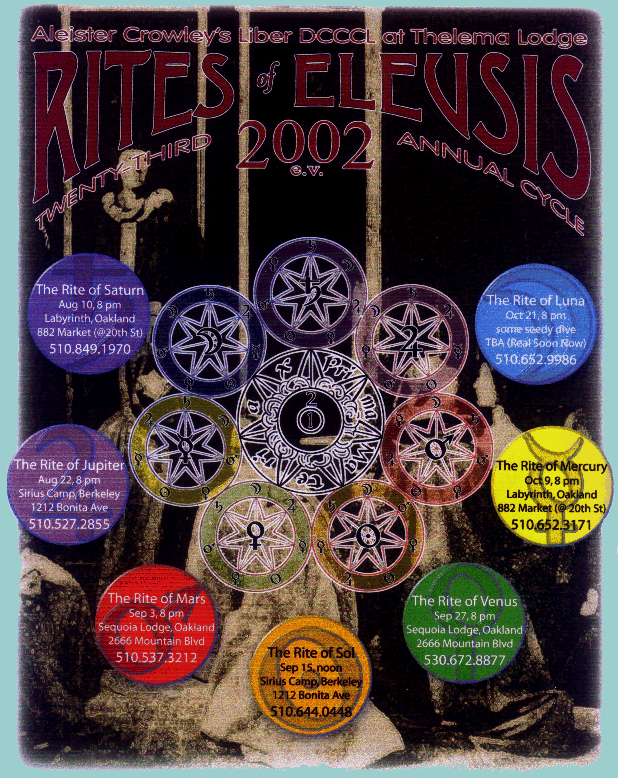
of Aleister Crowley's Liber 850, The Rites of Eleusis, beginning at 8:00
on Saturday evening 10th August.
The abominable Baron herself,
beckoning out of her big box, will
catch you and carry you away into
the labyrinth of black. Join Leigh
Ann for "The Rite of Saturn" in the
Labyrinth at Market & 20th Streets
in Oakland.
Destruction's Formidable Kiss
Eleusis continues at intervals of
twelve days on into the autumn.
Jupiter is next, at Sirius
Encampment, beginning at 8:00 on
Thursday evening 22nd August in
north Berkeley. Call Glenn at (510)
527-2855 during the preceding week
for directions. Dress in purples
and rich blues (or not at all, as
this may be rather a wet rite), and
come bearing gifts of wine and fruit
and joviality. Maenads and tigers
will be welcome volunteers at the
last minute, should the spirit move
you!
Like a Flower in the Heart
Sirius Encampment offers a
seminar on the symbolism of the
O.T.O. first degree ritual, with
attendance limited to I° initiates.
At 2:00 on Sunday afternoon 25th
August in north Berkeley,
participants will take the ritual
apart for a discussion both of the
candidate's experience and the
officers' roles in this degree.
Experienced officers and new members
of the first degree will be
especially welcome.
At Thelema Lodge O.T.O.
initiations this month will be held
on Saturday 31st August. Candidacy
must be arranged at least thirty
days ahead, and all who attend must
speak well in advance with the lodge
officers to known the time, place,
and degree to be worked. Candidacy
in the Man of Earth degrees is
available by application; request
the proper form for your next degree
from the lodgemaster.
Beyond the Ogdoadic Region
The Corpus Hermeticum is our
topic for the Section Two reading
group this month, meeting with
Caitlin in the lodge library from
8:00 to 9:30 on Monday evening 19th
August. In the first section of his
reading list Crowley recommends the
"Hermetic" books under the title of
the first dialogue in this series of
esoteric teachings. The A A
bibliography entry reads (in full):
"The Divine Pymander, by Hermes
Trismegistus. Invaluable as bearing
on the Gnostic Philosophy." The
Hermetica comprise a small library
of eighteen brief pedagogic
dialogues, plus a longer essay on
Egyptian temple techniques entitled
"Asclepius." They are pagan, but
with a monotheistic leaning, and
primarily concerned with
theosophical piety and with Egyptian
spiritual traditions. They seem to
emerge from the Greek-speaking
administrative society which
governed Egypt as part of the Roman
empire, and they date from the
second and third centuries of the
common era. Ascribed to Hermes, or Thoth, the inventor of writing,
these pseudopigraphic teachings
attempt to reconstruct a primal
perspective from the very beginning
of human culture, and present
themselves as the earliest written
records of the world's oldest
civilization. Hermes Trismegistus
(the Master of Three Arts, or the
Thrice-Greatest), a form of Tahuti,
was long held to have been an older
contemporary of Moses, and to bear
witness to a spiritual tradition
parallel to that of the Torah. The
recovery of these texts was seen (at
the time) as a turning point in the
Italian Renaissance, and their
translation into Latin by Ficino
preceded his edition of Plato. In
fact the Hermetica seem almost to be
the writings of tourists in Egypt,
impressed but confused, and
concerned mainly with external and
accidental curiosities. They
contain diverse syncretic elements
from many religious traditions
current in the Roman empire,
including some clear echoes of
Genesis. In the early seventeenth
century Greek scholarship was able
to date these texts more accurately,
and they lost their status as the
primal evidence of an archaic
spirituality. We read them partly
for the impression they made upon
the great magicians of the
Renaissance who accepted them at
face value, and partly as a record
of the classical pagan spiritual
culture which fabricated them, and
partly for the view they afford of
their actual authors' projections of
the archaic beginnings of the human
spirit which they attempted to
reconstruct.
A
bibliography entry reads (in full):
"The Divine Pymander, by Hermes
Trismegistus. Invaluable as bearing
on the Gnostic Philosophy." The
Hermetica comprise a small library
of eighteen brief pedagogic
dialogues, plus a longer essay on
Egyptian temple techniques entitled
"Asclepius." They are pagan, but
with a monotheistic leaning, and
primarily concerned with
theosophical piety and with Egyptian
spiritual traditions. They seem to
emerge from the Greek-speaking
administrative society which
governed Egypt as part of the Roman
empire, and they date from the
second and third centuries of the
common era. Ascribed to Hermes, or Thoth, the inventor of writing,
these pseudopigraphic teachings
attempt to reconstruct a primal
perspective from the very beginning
of human culture, and present
themselves as the earliest written
records of the world's oldest
civilization. Hermes Trismegistus
(the Master of Three Arts, or the
Thrice-Greatest), a form of Tahuti,
was long held to have been an older
contemporary of Moses, and to bear
witness to a spiritual tradition
parallel to that of the Torah. The
recovery of these texts was seen (at
the time) as a turning point in the
Italian Renaissance, and their
translation into Latin by Ficino
preceded his edition of Plato. In
fact the Hermetica seem almost to be
the writings of tourists in Egypt,
impressed but confused, and
concerned mainly with external and
accidental curiosities. They
contain diverse syncretic elements
from many religious traditions
current in the Roman empire,
including some clear echoes of
Genesis. In the early seventeenth
century Greek scholarship was able
to date these texts more accurately,
and they lost their status as the
primal evidence of an archaic
spirituality. We read them partly
for the impression they made upon
the great magicians of the
Renaissance who accepted them at
face value, and partly as a record
of the classical pagan spiritual
culture which fabricated them, and
partly for the view they afford of
their actual authors' projections of
the archaic beginnings of the human
spirit which they attempted to
reconstruct.
Previous Section Two Next Section Two
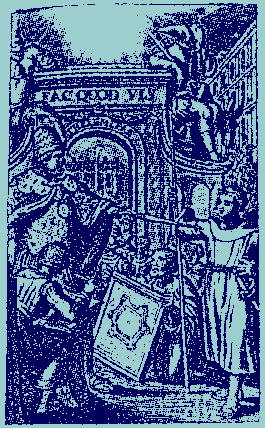 | |
Fac Quod Vis Totum Legis Erit
"Do what thou wilt shall be the
whole of the Law." The accompanying
figure, an eighteenth century
engraving illustrating a French
edition of Gargantua by Rabelais,
shows the entrance to the original
Abbey of Thelema. The triple-
crowned Pope stands before the gate,
inspecting a ground plan of Thélème
on his visit to the abbey. Upon the
lintel appears the abbey's motto in
Latin, reminding us that although
Rabelais wrote in French he lived
largely in a latinate culture, and
doubtless would have imagined the
Latin language as basic to the
institution of his idealized
coeducational monastery. Below this
motto, on the archway of the gate,
the single word "Thelemae" has been
inscribed.
Amor lex est, amor sub voluntatem. | |
Rites in Review
The two items in this section appeared in a program leaflet distributed in 1910 e.v. to patrons at the original Rites of Eleusis
performances at Caxton Hall in London. Headed simply "The Rites of Eleusis," the first article seems to have been written especially for this leaflet, most likely by one of the participants in the production. Its style and perspective are distinct from Crowley's own, and this anonymous piece was apparently not published elsewhere. The second item reprinted here from the Caxton Hall program leaflet is a review by Raymond Radclyffe which had been published on 24th August 1910 e.v. in a London arts magazine called The
Sketch. It describes the original invitational performance of "The Rite of Artemis," which was later recast as "The Rite of Luna" and became the prototype for the other rites in the Eleusis cycle. An abbreviated version of Radclyffe's review appeared in this column last year (TLC, September 2001 e.v.) when no complete text was avaliable; the present version restores several paragraphs at the opening and closing of the piece. The essay by Aleister Crowley which appears in the following "Crowley Classics" section was the third and final item in the Caxton Hall leaflet. It too seems not to have been published elsewhere in its present form, although sections of it were borrowed in other publicity material distributed from the Equinox offices at the time of the Rites production. Thelema Lodge again thanks Caliph Hymenaeus Beta for providing a photocopy of the rare 1910 e.v. theater program from which all three of these texts are reprinted.
The Rites of Eleusis
"We are the poets! We are the children of wood and stream, of mist and mountain, of sun and wind! We are the Greeks! and to us the rites of Eleusis should open the doors of Heaven, and we shall enter in and see God face to face. . .
Under the stars will I go forth, my brothers, and drink of that lustral dew: I will return, my brothers, when I have seen God face to face and read within those eternal eyes the secret that shall make you free.
Then will I choose you and test you and instruct you in the Mysteries of Eleusis, of ye brave hearts, and cool eyes, and trembling lips! I will put a live coal upon your lips, and flowers upon your eyes, and a sword in your hearts, and ye also shall see God face to face.
Thus shall we give back its youth to the world, for like tongues of triple flame we shall look upon the great Deep -- Hail unto the Lords of the Groves of Eleusis!
-- ALEISTER CROWLEY in "Eleusis." |
Aleister Crowley is one of those
men who can never remain satisfied.
His ambitions are insatiable. He
desires the unattainable with the
fervour of a fanatic. Whether he is
climbing volcanoes in Mexico or
traversing the vase snowfields of
Kinchinjunga, editing a paper or
playing golf, he proceeds on his way
with swiftness and passion. In
Ceylon he was a Buddhist. In Paris
he was the beloved of Rodin.
Wherever he may be he must lead the
way. Whilst Maeterlinck was
delicately suggesting that there was
more in magic than most of us
imagined, Crowley was saturating
himself in all the mystical works of
the middle ages. He learnt Magic as
certainly no living man has ever
learnt it.
Eighteen months ago he started a
periodical called The Equinox,
brilliant from first page to last.
Some of it is pure literature; some
semi-magical: the greater portion
intended for the study of those who
see a serious side to Ceremonial
Magic. The Equinox has been a great
success. Even those who have never
heard of the Taro or read Eliphas
Levi buy The Equinox.
Aleister Crowley is a poet; no
minor bard twittering in gentle
verses the praises of his mistress's
eyelash, but a virile singer, robust
in his hates, passionate in his
loves. He may not be as morbid as
Baudelaire, but he is bolder than
Swinburne. And he has equal mastery
of verse. But he is still a young
man, and so only known to a select
circle. It is certain that one of
these days Crowley will be
considered to rank with Coleridge,
Shelley, Keats, and Swinburne. In
many of his poems he strikes the
highest note.
Crowley is not only a poet, he is
also a philosopher. He studies
mankind from outside. He earnestly
desires to help humanity. He
believes that he has a mission in
the world. He is so much in earnest
that he has already a large
following amongst those who, whilst
essentially religious, have no
creed. Captain Fuller has written a
book upon Crowley and his aims. In
this book he not only calls
attention to the poems of the
writer, but he devotes some hundred
odd pages to the new philosophy that
is to lead mankind to happiness and
a nobler life. What is this
philosophy? It is devoted to a
search after Ecstasy, and is called
Scientific Illuminism. "Religion
and Science for many years seemingly
ran antagonistic to each other; but
in reality their antagonism has been
of a superficial nature, and
fundamentally they at heart are
one," thus writes Captain Fuller,
whom we may accept as an authority.
Crowley is the mouthpiece of a
society the object of which would
seem to be the attaining of
religious ecstasy by means of
Ceremonial Magic.
Dr Maudsley defines Ecstasy or
Samadhi as a quasi-spasmodic
standing-out of a special tract of
the brain. W. R. Inge defines
Ecstasy as a vision that proceeds
from ourselves when conscious
thought ceases. But however you may
feel about Ecstasy there is no doubt
that it is an essential part of true
religious feeling. Crowley says,
"True Ceremonial Magic is entirely
directed to attain this end, and
forms a magnificent gymnasium for
those who are not already finished
mental athletes." By act, word, and
thought, both in quantity and
quality, the one object of the
ceremony is being constantly
indicated.
In order to induce this religious
ecstasy in its highest form Crowley
proposes to hold a series of
religious services; seven in number.
These services are to be held in
Caxton Hall, Westminster, and will
be conducted by Aleister Crowley
himself, assisted by other Neophytes
of the A A, the mystical society, one of whose Mahatmas is responsible
for the foundation of The Equinox.
The seven services will be
typical of Shakespeare's Seven Ages
of Man, and each one will be
dedicated to the Planet that rules
its particular age. For example,
Saturn "the lean and slippered
pantaloon," or sad old age. Jupiter
the solemn and portentous justice,
the serious and serene man who has
arrived and controls. Mars the
soldier, full of energy and life,
vigorous and formidable. Sol the
man who has still something of his
youth left, and is gay betimes and
serious betimes, the man who loves
and the man who works. Venus
explains itself in Shakespeare's
words, "the lover with a woeful
ballad." Mercury the schoolboy,
happy, careless and gay, mischievous
and full of animal life. Luna the
age of childhood and innocence,
unsmirched and white as the planet
herself.
Each will have its own ritual,
arranged for the purpose of
illustrating the particular deity to
which it is devoted; each ritual
will be both poetic and musical.
Verses of the great poets
appropriate to the planet and all
that the planet represents will be
recited, and the ideas suggested to
the spectators will be translated
into inspired music by an
accomplished violin player. There
will further by mystical dances by a
brilliant young poet who thus draws
down the holy influence.
The ceremonies will commence at
nine o'clock precisely, and no one
will be admitted after that hour.
They will occupy about two hours,
and those who attend will be
requested to centre their whole
minds upon the idea of the evening,
the object, of course, being to
induce in the spectators a feeling
of religious ecstasy.
One hundred seats only will be
available and the rent for these
seats for the seven ceremonies will
be five guineas. The proceeds will
be devoted to The Equinox, and the
object for which The Equinox was
established.
The following is a description of
a ceremony in honour of Artemis held in July at the offices of The Equinox. The present series will be
even more elaborate and perfect.
A New Religion
by Raymond Radclyffe
A certain number of literary
people know the name of Aleister
Crowley as a poet. A few regard him
as a magician. But a small and
select circle revere him as the
hierophant of a new religion. This
creed Captain Fuller, in a book on
the subject extending to 327 pages,
calls "Crowleyanity." I do not
pretend to know what Captain Fuller
means. He is deeply read in
philosophy, and he takes Crowley
very seriously. I do not quite see
whither Crowley himself is driving;
but I imagine that the main idea in
the brain of this remarkable poet is
to plant Eastern Transcendentalism,
which attains its ultimate end in
Samadhi, in English soil under the
guise of Ceremonial Magic.
Possibly the average human being
requires and desires ceremony. Even
the simplest Methodist uses some
sort of ceremony, and Crowley, who
is quite in earnest in his endeavour
to attain such unusual conditions of
mind as are called ecstasy, believes
that the gateway to Ecstasy can be
reached through Ceremonial Magic.
He has saturated himself with the
magic of the East -- a very real
thing, in tune with the Eastern
mind. He is well read in the modern
metaphysicians, all of whom have
attempted to explain the
unexplainable.
He abandons these. They appeal
only to the brain, and once their
jargon is mastered they lead
nowhere; least of all to Ecstasy.
He goes back upon ceremony, because
he thinks that it helps the mind to
get outside itself. He declares
that if you repeat an invocation
solemnly and aloud, "expectant of
some great and mysterious result,"
you will experience a deep sense of
spiritual communion.
He is now holding a series of
seances.
I attended at the offices of The Equinox. I climbed the interminable stairs. I was received by a
gentleman robed in white and
carrying a drawn sword.
The room was dark; only a dull-
red light shone upon an altar.
Various young men, picturesquely
clad in robes of white, red, or
black, stood at different points
around the room. Some held swords.
The incense made a haze, through
which I saw a small white statue,
illumined by a tiny lamp hung high
on the cornice.
A brother recited "the banishing
ritual of the Pentagram"
impressively and with due
earnestness. Another brother was
commanded to "purify the Temple with
water." This was done. Then we
witnessed the "Consecration of the
Temple with Fire," whereupon
Crowley, habited in black, and
accompanied by the brethren, led
"the Mystic Circumambulation." They
walked round the altar twice or
thrice in a sort of religious
procession. Gradually, one by one,
those of the company who were mere
onlookers were beckoned into the
circle. The Master of the
Ceremonies then ordered a brother to
"bear the Cup of Libation." The
brother went round the room,
offering each a large golden bowl
full of some pleasant-smelling
drink. We drank in turn. This
over, a stalwart brother strode into
the centre and proclaimed "The
Twelvefold Certitude of God."
Artemis was then invoked by the
greater ritual of the Hexagram.
More Libation. Aleister Crowley
read us "The Song of Orpheus" from
The Argonauts.
Following upon this song we drank
our third Libation, and then the
brothers led into the room a draped
figure, masked in that curious blue
tint we mentally associate with
Hecate. The lady, for it was a lady,
was enthroned on a seat high above
Crowley himself. By this time the
ceremony had grown weird and
impressive, and its influence was
increased when the poet recited in
solemn and reverent voice
Swinburne's glorious first chorus
from "Atalanta," that begins "When
the hounds of spring." Again a
Libation; again an invocation to Artemis. After further ceremonies,
Frater Omnia Vincam was commanded to
dance "the dance of Syrinx and Pan
in honour of our lady Artemis." A
young poet, whose verse is often
read, astonished me by a graceful
and beautiful dance, which he
continued until he fell exhausted in
the middle of the room, where, by
the way, he lay until the end.
Crowley then made supplication to
the goddess in a beautiful and
unpublished poem. A dead silence
ensued. After a long pause, the
figure enthroned took a violin and
played -- played with passion and
feeling, like a master. We were
thrilled to our very bones. Once
again the figure took the violin,
and played an Abend Lied so
beautifully, so gracefully, and with
such intense feeling that in very
deed most of us experienced that
Ecstasy which Crowley so earnestly
seeks. Then came a prolonged and
intense silence, after which the
Master of Ceremonies dismissed us in
these words: "By the Power in me
vested, I declare the Temple
closed."
So ended a really beautiful
ceremony -- beautifully conceived
and beautifully carried out. If
there is any higher form of artistic
expression than great verse and
great music I have yet to learn it.
I do not pretend to understand the
ritual that runs like a thread of
magic through these meetings of the
A A I do not even know what the
A A is. But I do known that the
whole ceremony was impressive,
artistic, and produced in those
present such a feeling as Crowley
must have had when he wrote:
So shalt thou conquer Space, and lastly climb
The walls of Time;
And by the golden path the great trod
Reach up to God! |
|

Crowley Classics
This essay on The Rites of Eleusis appeared late in 1910 e.v. in the same program leaflet from which the two foregoing "Rites in Review" articles have been reprinted.
The Why and How of Ecstasy
by Aleister Crowley
"There is a land of pure delight,
Where saints immortal reign." |
So used some of us to sing in our
childhood. And we used to think of
this land as far away, farther even
than death that in those days seemed
so far.
But I know this now: that land is
not so far as my flesh is from my
bones! It is even Here and Now.
If there is one cloud in this
tranquil azure, it is this thought;
that conscious beings exist who are
not thus infinitely happy, masters
of ecstasy.
So to remove this cloud have I
cheerfully dedicated all I have and
all I am.
That I do not overvalue ecstasy
is shown by this, that I am not one
who denies himself the good things
of this world. There are too many
mystics going about like the fox who
lost his brush. They cannot enjoy
life, and so make believe to have
something better.
But I dine at the Cafe Royal,
instead of munching nuts and
"sirloin of carrots." I make
expeditions to the great mountains
of the Himalayas, and hunt buffalo
and tiger in the jungles of the
Terai; I love beauty in painting and
sculpture; I love poetry and music;
and I love flesh and blood.
There is nothing that you enjoy
that I do not enjoy as much as you
do; and I bear witness that nothing
is worthy to be compared with
ecstasy.
What is the path to this immortal
land?
To the Oriental, whose mind is,
so to say, static, meditation offers
the best path, a path which to us
seems (and indeed is) intolerably
irksome and tedious.
To the Western, whose mind is
active and dynamic, there is no road
better than ceremonial.
For ecstasy is caused by the
sudden combination of two ideas,
just as hydrogen and oxygen unite
explosively.
A similar instance in a higher
kingdom will occur to every one.
But this religious ecstasy takes
place in the highest centres of the
human organism; it is the soul
itself that is united to its God;
and for this reason the rapture is
more overpowering, the joy more
lasting, and the resultant energy
more pure and splendid, than in
aught earthly.
In ritual, therefore, we seek
continually to unite the mind to
some pure idea by an act of will.
This we do again and again more and
more passionately, with more and
more determination, until at last
the mind accepts the domination of
the Will, and rushes of its own
accord toward the desired object.
This surrender of the mind to its
Lord gives the holy ecstasy which we
seek. It is spoken of in all
religions, usually under the figure
of the bride going forth to meet the
bridegroom. It is the attainment of
this which makes the saint and the
artist.
Now in our ceremonies we
endeavour to help everybody present
to experience this. We put the mind
of the spectator in tune with the
pure idea of austerity and
melancholy which we call Saturn, or
with the idea of force and fire
which we call Mars, or with the idea
of nature and love which we call
Venus, and so for the others. If he
becomes identified with this idea
the union is one of ecstatic bliss,
and its only imperfection is due to
the fact that the idea in question,
whatever it may be, is only partial.
Ecstasy is therefore progressive.
Gradually the adept unites himself
with holier and higher ideas until
he becomes one with the Universe
itself, and even with That which is
beyond the Universe. To him there
is no more Death; time and space are
annihilated; nothing is, save the
intense rapture that knows no change
for ever.
Then what of the body? The body
of such an one continues subject to
the laws of its own plane. Yet his
friends find him calmer, happier,
healthier, his eyes bright and his
skin clear even when he is old. but
he has this, which they have not,
the power of slipping instantly out
of this changeful consciousness into
the Eternal, and then abiding,
supremely single and complete,
bathed in unutterable bliss, one
with the All. And he knows that
this body subject to disease and
Death is not himself, but only as it
were the instrument of his pleasure,
a sort of houseboat that he has
taken for the summer.
The present series of ceremonies
is designed for beginners, for those
who have as yet no experience at
all.
Only the simplest formulas will
be used, so that even those who are
quite unfamiliar with the methods
and aims of ritual may obtain the
result, and comprehend the method.
Yet they will be profound and
perfect, so that even those who are
already skillful may obtain further
success.
Let us add a short analysis of
the present series of rites; they
may be taken as illustrating
Humanity, its fate both good and
evil.
Man, unable to solve the Riddle
of Existence, takes counsel of
Saturn, extreme old age. Such
answer as he can get is the one word
"Despair."
Is there more hope in the dignity
and wisdom of Jupiter? No; for the
noble senior lacks the vigour of
Mars the warrior. Counsel is in
vain without determination to carry
it out.
Mars, invoked, is indeed capable
of victory: but he has already lost
the controlled wisdom of age; in the
moment of conquest he wastes the
fruits of it, in the arms of luxury.
It is through this weakness that
the perfected man, the Sun, is of
dual nature, and his evil twin slays
him in his glory. So the triumphant
Lord of Heaven, the beloved of
Apollo and the Muses is brought down
into the dust, and who shall mourn
him but his Mother Nature, Venus, the lady of love and sorrow? Well
is it if she bears within her the
Secret of Resurrection!
But even Venus owes all her charm
to the swift messenger of the gods,
Mercury, the joyous and ambiguous
boy whose tricks first scandalize
and then delight Olympus.
But Mercury, too, is found
wanting. Not in him alone is the
secret cure for all the woe of the
human race. Swift as ever, he
passes, and gives place to the
youngest of the gods, to the
Virginal Moon.
Behold her, Madonna-like, throned
and crowned, veiled, silent,
awaiting the promise of the Future.
She is Isis and Mary, Istar and
Bhavani, Artemis and Diana.
But Artemis is still barren of
hope until the spirit of the
infinite All, great Pan, tears
asunder the veil and displays the
hope of humanity, the Crowned Child
of the Future. All this is
symbolized in the holy rites which
we have recovered from the darkness
of history, and now in the fullness
of time disclose that the world may
be redeemed.
For the corruptible shall put on
incorruptibility, the mortal shall
put on immortality; my adepts shall
walk crowned in the Gardens of the
World, enjoying the breeze and the
sunlight, plucking the roses and
filling their mouths with ripe
grapes. They shall dance in the
moonlight before Dionysus, and
delight under the stars with
Aphrodite; yet they shall also dwell
beyond all these things in the
unchanged Heaven -- Here and Now.
T H E R I T E S O F E L E U S I S
will be celebrated at Caxton Hall,
Westminster, as follows:
| THE RITE OF SATURN | | 9 p.m. Wednesday, Oct. 19th. |
| THE RITE OF JUPITER | 9 p.m.
Wednesday, Oct. 26th. |
| THE RITE OF MARS | 9 p.m. Wednesday,
Nov. 2nd. |
| THE RITE OF SOL | 9 p.m. Wednesday,
Nov. 9th. |
| THE RITE OF VENUS | 9 p.m.
Wednesday, Nov. 16th. |
| THE RITE OF MERCURY | 9 p.m.
Wednesday, Nov. 23rd. |
| THE RITE OF LUNA | 9 p.m. Wednesday,
Nov. 30th. |
Tickets will not be sold
separately; the rent for the series
is Five Guineas. Tickets are,
however, transferable. Doors will
be open at 8:30; they will be closed
and locked at Nine o'clock
precisely. The ceremonies occupy
from 1 to 2 hours.
ONLY ONE HUNDRED TICKETS WILL BE
ISSUED; EARLY APPLICATION IS
THEREFORE DESIRABLE.
Application for seats should be
made to the Manager,
| THE EQUINOX, |
124, Victoria Street, |
London, S.W. |
Telephone: 3210 Victoria.
NOTE
For the Rite of Saturn you are
requested, if convenient, to wear
black or very dark blue, for Jupiter
violet, for Mars scarlet or russet
brown, for Sol orange or white, for
Venus green or sky-blue, for Mercury
shot silk and mixed colours, for
Luna white, silver, or pale blue.
It is not necessary to confine
yourself to the colour mentioned,
but it should form the keynote of
the scheme.
The etiquette to be observed is
that of the most solemn religious
ceremonies. It should be
particularly borne in mind that
silence itself is used as a means of
obtaining effects.
Previous Crowley Classic Next Crowley Classic
from the Grady Project:
Originally published in The Magickal
Link volume II, number 10 (October 1982) on pages 1-2.
On the Holy Books
by Hymenaeus Alpha 777
Traditionally we have accepted
six of Aleister Crowley's works as
"the Holy Books." They are Liber
AL, Liber Cordis Cincti Serpente
(Liber LXV), Liber Liberi vel Lapis
Lazuli (Liber VII), Liber DCCCXIII
vel Ararita, History Lection (Liber
LXI), and Liber Trigrammaton. I
verified this with Germer twenty
years ago when some doubt arose.
They were originally published by
Crowley in a small three-volume set
very expensively in white leather
with gold stamping and were entitled  in Greek. Of these we will
consider Liber VII, Liber LXV, and
Liber DCCCXIII. These poems, hymns
in praise of his H.G.A., are a
record of the highest spiritual
attainment: the Knowledge and
Conversation of the Holy Guardian
Angel, the Crossing of the Abyss,
VIII°, Magister Templi. And they
follow a curious pattern.
in Greek. Of these we will
consider Liber VII, Liber LXV, and
Liber DCCCXIII. These poems, hymns
in praise of his H.G.A., are a
record of the highest spiritual
attainment: the Knowledge and
Conversation of the Holy Guardian
Angel, the Crossing of the Abyss,
VIII°, Magister Templi. And they
follow a curious pattern.
In the first, Liber Liberi vel
Lapidis Lazuli VII, we have the
ecstatic breakthrough into
communication with that Unknown
where the poet knows union with the
geyser of the unconscious. II:11 --
Thou art like a beautiful Nubian slave leaning her naked purple against the green pillars of marble that are above the bath. The poetry
speaks for itself, but the pattern
is curious. If we take the formula
I A O, beginning with the "Prologue
of the Unborn" as an added chapter,
the pattern goes IAO, IAO, IAO, IA,
IA, IA, IA, IAO. One can presume
that the failure to reach that last
ecstatic "O" in the in-between
chapters were beautiful experiences
that were not quite completed.
Liber Cordis Concti Serpente vel
LXV (The Heart Girt with the Serpent) is the record of a more
mature experience of the same kind,
and is loaded with reverse
sexuality. As Crowley goes through
the various levels of experiencing
this phenomenon he slips in and out
of sex roles easily, as could be
expected at this height of tantric
androgyny. II:54 -- Crush out the blood of me, as a grape upon the tongue of a white Doric girl that languishes with her lover in the moonlight! III:40 -- I am become like a luscious devil of Italy; a fair strong woman with worn cheeks, eaten out with hunger for kisses.
And, III:50 -- That which went in as a brave boy of beautiful limbs cometh forth as a maiden, as a little child for perfection. Just
about as alchemical as you can get.
All of this is summed in the last
verse: So also is the end of the book, and the Lord Adonai is about it on all sides like a Thunderbolt, and a Pylon, and a Snake, and a Phallus, and in the midst thereof He is like the Woman that jetteth out the milk of the stars from her paps; yea, the milk of the stars from her paps.
With DCCCXIII vel Ararita we have
the culmination of this experience
recounted in a relaxed, almost
familiar style. For a taste of the
poetry we can try VII:7 -- At the touch of the Fire Qadosh the Brilliance of our Lord was absorbed in the Naught of our Lady of the Body of the Milk of the Stars. For
the pattern we notice the chapter
heads. Seen across the board they
run as follows:
| I | II | III | IV | V | VI | VIII |
| Aleph | Resh | Aleph | Resh | Yod | Tau | Aleph |
Obviously the formula of Ararita --


 -- its literal meaning and
noteriqon. This is the seven-fold
name used to command the seven
ancient planets in Renaissance
Ceremonial Magick. Agrippa, in his
Occult Philosophy, gives the
Noteriqon thusly:
-- its literal meaning and
noteriqon. This is the seven-fold
name used to command the seven
ancient planets in Renaissance
Ceremonial Magick. Agrippa, in his
Occult Philosophy, gives the
Noteriqon thusly:


The meaning of this is roughly:
"His principal is one, his
beginning is one, and his
permutations are one." The
gematria can be numbered out in
the usual way. It is not often
that a master of the Art can make
his intentions so plain.
Of the other three Holy Books,
Liber AL vel Legis and Liber
Trigrammaton can be ordered from
the O.T.O., and Liber LXI vel
Causae can be found in any copy of
"blue" Equinox.
These three Holy Books should
prove invaluable to the true
seeker of Initiation. May they
guide you in that quest.
Clear Light of the Void Encampment, Salt Lake City, Utah
-- consecrated to the destruction of the universe. |
Previous Grady Project Next Grady Project
from the Library Shelf
Reprinted from an edition of Everard's translation of the Divine Pymander (Madras, India: P. Kailasam Brothers, 1884).
Extracts from an Introduction
to the Divine Pymander
of Hermes Mercurius Trismegistus
by Hargrave Jennings
(1884)
The Greeks applied the name and
term of Hermes Mercurius
Trismegistus, so significant and
suggestive, certainly to the
Egyptian Thoth, as early as the
fourth century, B.C. He was
believed to be the origin of
everything formed or produced by
the human mind. He was,
therefore, esteemed as the
inventor of all the arts and
sciences. He was the contriver of
the hieroglyphics. Of these there
were various kinds. There was a
profound system of hieroglyphical
rendering, adopted among the
Egyptians, the true meaning of
which was only known to the higher
ranks of the priests. There were
other systems of representation by
marks of figures which were less
reserved, and some of these
mysterious signs were fitted, or
adapted, for the comprehension of
the multitude. Hermes was the
prolific and versatile interpreter
between nature and man; the
repository from which issued all
the application of the methods of
explaining the phenomena of nature
and their uses, perceived by the
human mind. In his hands, and through his means, lay the
demonstration of the conclusions
of reason.
The epithet, Trismegistus
( , or "superlatively"
greatest), as applied to Hermes,
is of comparatively late origin,
and cannot be traced to any author
earlier than the second Christian
century. Most probably, it arose
out of the earlier forms derived
by the Greeks from pristine
Egyptian sources. But various
other explanations of the
appellation have been offered,
such as that of the author of the
Choronicon Alexandrinum (47 A.D.),
who maintains that it was because
Hermes, while maintaining the
unity of God, had also asserted
the existence of three supreme or
greatest powers, that he was
called by the Egyptians
Trismegistus. This view, which is
also adopted by Suidas, seems
preferable at least to that met
with in Nicolai's History of Greek
Literature, according to which an
apocryphal author named Hermes was
called
, or "superlatively"
greatest), as applied to Hermes,
is of comparatively late origin,
and cannot be traced to any author
earlier than the second Christian
century. Most probably, it arose
out of the earlier forms derived
by the Greeks from pristine
Egyptian sources. But various
other explanations of the
appellation have been offered,
such as that of the author of the
Choronicon Alexandrinum (47 A.D.),
who maintains that it was because
Hermes, while maintaining the
unity of God, had also asserted
the existence of three supreme or
greatest powers, that he was
called by the Egyptians
Trismegistus. This view, which is
also adopted by Suidas, seems
preferable at least to that met
with in Nicolai's History of Greek
Literature, according to which an
apocryphal author named Hermes was
called  , simply in
order to indicate that he had
succeeded and outdone a certain
Megistias of Smyrna in
astrological, physiognomical, and
alchemistic theories. The name of
Hermes seems during the third and
following centuries to have been
regarded as a convenient pseudonym
to place at the head of the
numerous syncretistic writings in
which it was sought to combine
Neo-Platonic philosophy, Philonic
Judaism, and cabalistic theosophy,
and to provide the world with some
acceptable substitute for the
Christianity which had even at
that time begun to give
indications of the ascendancy it
was destined afterwards to attain.
Of these pseudepigraphic Hermetic
writings, some have come down to
us in the original Greek. Others
survive in Latin or Arabic
translations. But the majority
appear to have perished.
, simply in
order to indicate that he had
succeeded and outdone a certain
Megistias of Smyrna in
astrological, physiognomical, and
alchemistic theories. The name of
Hermes seems during the third and
following centuries to have been
regarded as a convenient pseudonym
to place at the head of the
numerous syncretistic writings in
which it was sought to combine
Neo-Platonic philosophy, Philonic
Judaism, and cabalistic theosophy,
and to provide the world with some
acceptable substitute for the
Christianity which had even at
that time begun to give
indications of the ascendancy it
was destined afterwards to attain.
Of these pseudepigraphic Hermetic
writings, some have come down to
us in the original Greek. Others
survive in Latin or Arabic
translations. But the majority
appear to have perished.
***** ***** *****
The connection of the name of
Hermes with alchemy will explain what is meant by "hermetic
sealing," and will account for the
use of the phrase "hermetic
medicine" by Paracelsus, as also
for the so-called "hermetic
freemasonry" of the Middle Ages.
Hermes was called by the
Egyptians TAT, TAUT, THOTH. It is
concluded that, because of his
learning and address, and in
wonder at his profound skill in
the arts and sciences, that the
people gave him the name of
TRISMEGISTUS, or the "THRICE
GREAT." Thoth -- or the being
named with these varieties of
appellation, Tat, Tot, Taut, Thoth
-- was the counselor and friend of
Osiris. This much has been
declared of him by Diodorus
Siculus. He was left by Osiris to
assist Isis with his counsels in
the government of the country,
when Osiris embarked in the design
of regenerating the earth, and
visiting and civilizing the
several nations. The historian
adds that Hermes improved
language, invented letters,
instituted religious rites, taught
mankind a consistent and
philosophical knowledge of
Providence, instructed in
astronomy, music, and other arts.
Many are of opinion that this
Thoth, or Hermes, lived long
before the time of Moses. Some
have been so fanciful as to make
him one with ADAM, while nearly
all historiographers, in
surrounding his character and
doings with mystery, ascribe to
him the power of magic, if not the
very invention of magic itself.
There have not been wanting those
who have looked upon him as the
same person as ENOCH or CANAAN, or
as the patriarch JOSEPH. Perhaps
-- in spite of all the foregoing
exaggerations, which are always
the lot of very great and highly
distinguished men, who become
deified in after-times -- the most
probable judgment to be formed
concerning him is, that he was
some person of superior genius,
who, before the time of Moses, and
invented useful arts, and taught
the first rudiments of science;
and who caused his instructions to be engraved in emblematical
figures (hieroglyphics), upon
tablets or columns of stone
(obelisks), which he dispersed
over the country, for the purpose
of enlightening the people, and of
fixing the worship of the gods.
And it is reasonable to conclude
that the same symbolical
inscriptions were made use of in
calling up and inspiring the awe
inseparable from the contemplation
of spiritual beings -- the
guardians of the lives of men, and
the disposers of their fates.
Maxims of political and moral
wisdom went hand in hand with
these religious teachings.
Another Thoth, or Hermes, is
said to have lived at a later
period. He was equally celebrated
with the former, and to him is
particularly appropriated, by
some, the name of Trismegistus.
According to Manetho, he
translated from engraved tablets
of stone, which had been buried in
the earth, the sacred characters
of the first Hermes, and wrote the
explanation of them in books,
which were deposited in the
Egyptian temples. The same author
calls him the son of Agathodaemon;
and adds, that to him are ascribed
the restoration of the wisdom
taught by the first Hermes, and
the revival of geometry,
arithmetic, and the arts, among
the Egyptians, after they had been
long lost or neglected. By the
interpretation which he gave of
the symbols inscribed upon the
ancient tablets or columns, he
obtained the sanctions of
antiquity to his own institutions.
To perpetuate their influence upon
the minds of the people, he
committed the columns, with his
own interpretation, to the care of
the priesthood. Hence, he
obtained a high degree of respect
among the people, and was long
revered as the restorer of
learning and the arts. He is said
to have written a very large
number of books, as commentaries
upon the tables of the first
Hermes, which treated of universal
principles, of the nature of the
universe, and of the soul of man; of the governing of the world by
the movements of the stars
(otherwise in astrology); of the
Divine light, and of its shadow,
or of its OTHER SIDE (presented
away), in the MORTAL LIFE, or of
the articulate breath or
inspiration, or means of being in
this world -- which, in
contradistinction to the life of
the unbodied light, is the
DARKNESS. All these ultra-
profound ideas were treated of in
the theosophical teaching
(strictly Platonic, as it
afterwards became) of HERMES, the
"THRICE GREAT." He discourses of
the nature and orders of the
celestial brings; the populace of
the elements; and herein he
enumerates all the cabalistic
notions of the ROSICRUCIANS. He
reduces astrology to a system; he
produces treatises on medicine;
and enlarges, in a brilliant and
inspired manner, on all the
positive and recognizable side of
anatomy, and also upon the
mysticism connected with the
origin and working of the world,
and of the nature of the life of
MAN. Clemens of Alexandria gives
an account of his having written
thirty-two books upon theology and
philosophy, and six upon medicine,
and mentions the particular
subjects of some of them; but they
are no longer in existence. The
two dialogues which have been
attributed to him ... --
"Pymander" and "Asclepius" -- so
known from the names of the
principal speakers in them, are
most striking and eloquent, They
give eloquent proof of the
greatness of the author, real or
supposed. But we are inclined to
the opinion that he was a real
being, supernaturally gifted; and
thus offering to the world two
characters -- the one human, the
other spiritual and divine.
The titles appropriated to
HERMES MERCURIUS TRISMEGISTUS
were, in part, the titles of the
DEITY. THEUTH, THOTH, TAUT,
TAANTES, are the same title
diversified, and they belong to
the chief god of Egypt. Eusebius
speaks of him as the same as HERMES. From Theuth the Greeks
formed  , or Theos, which with
that nation was the most general
name of the Deity. Plato, in his
treatise named Philebus, mentions
him by the name of
, or Theos, which with
that nation was the most general
name of the Deity. Plato, in his
treatise named Philebus, mentions
him by the name of  , or
Theuth. He was looked upon as a
great benefactor, and the first
cultivator of the vine. He was
also supposed to have found out
letters, which invention is
likewise attributed to Hermes.
Suidas calls him Theus, and says
that he was the same as Arez, and
so worshipped at Petra. Instead
of a statue there was, "Lithos
melas, tetragonos, atupotos," a
black square pillar of stone,
without any figure or
representation. It was the same
deity which the Germans and Celtae
worshipped under the name of
Theut-Ait or Theutates; whose
sacrifices were very cruel ...
, or
Theuth. He was looked upon as a
great benefactor, and the first
cultivator of the vine. He was
also supposed to have found out
letters, which invention is
likewise attributed to Hermes.
Suidas calls him Theus, and says
that he was the same as Arez, and
so worshipped at Petra. Instead
of a statue there was, "Lithos
melas, tetragonos, atupotos," a
black square pillar of stone,
without any figure or
representation. It was the same
deity which the Germans and Celtae
worshipped under the name of
Theut-Ait or Theutates; whose
sacrifices were very cruel ...
The Hermetic of Hermetical art
is a name given to chemistry, on
the supposition that HERMES
TRISMEGISTUS was the inventor of
chemistry, or that he excelled in
it. Very little is known, indeed,
of this Hermes, and still less of
how much or how little he had to
do with the invention of the art
of chemistry. He is reputed to be
an ancient king of Egypt by some
who have endeavoured to trace his
history. The era of Aesculapius
is ancient enough, but these
explorers will insist that the age
of HERMES TRISMEGISTUS far
proceeded it. These assign his
time to a thousand years before
the period of the Aesculapius.
They carry HERMES TRISMEGISTUS
into perfect mystery. Zozimus
Panopolity mentions him as having
wrote of natural things, and there
are many pieces existent under his
name which are certainly -- to
speak the least of them -- under
some doubt.
***** ***** *****
HERMES TRISMEGISTUS is
generally asserted by the
alchemists to have been a priest,
who lived a little after the time
of Moses. According to Clemens
Alexandrinus, he was the author of forty-two books, containing all
the learning of the Egyptians.
Others tell us that he was the
author of several thousand
volumes. Plato speaks of him in
the Phaedrus as the inventor of
numbers and letters. He was, in
fact, the Egyptian god of letters,
and as such, of course, could be
described as the author of
multitudinous works. He was the
deified intellect, and hence has
often been confounded with THOTH,
the "intellect." Sir Gardner
Wilkinson speaks of HERMES as an
emanation of THOTH, and as
representing the "abstract
quality" of the understanding. It
may be well to note the extent of
the symbolism associated with the
sculptured representations, and
with the hieroglyphics associated
with the name of HERMES
TRISMEGISTUS. In one hand Hermes
holds the crux ansata, the symbol
of life -- a master symbol which
is the most persistent and
determined in its appearance (and
in its re-appearance) in all the
sculptures of Egypt -- in the
other hand the figure grasps a
staff, associated with which are a
serpent, a scorpion, a hawk's
head, and above all a circle
surrounded by an asp, each with
its special symbolical
significance. On the Rosetta
stone Hermes is called the "great
and great," or "twice" great. He
was called TRISMEGISTUS, or
"thrice great," according to the
twelfth aphorism of the Emerald
Tablet, because he possessed three
parts of the wisdom of the whole
world.
Previous from the Library Shelf Next from the Library Shelf
Thelema Lodge Events Calendar for August 2002 e.v.
| 8/4/02 | | Gnostic Mass 8:00PM Horus Temple | | (510) 652-3171 | | Thelema Ldg. |
| 8/7/02 | Feast of Lamas. Cook-out at Lake
Temescal, 7PM (rides from the lodge
leaving 6:30) | (510) 652-3171 | Thelema Ldg. |
| 8/8/02 | New Moon in Leo 12:15 PM |
| 8/10/02 | The Rite of Saturn at the Labyrinth
(Market at 20th) in Oakland 8:00PM |
| 8/11/02 | Gnostic Mass 8:00PM Horus Temple | (510) 652-3171 | Thelema Ldg. |
| 8/12/02 | Feast of the Beast and His Bride 7:00PM | (510) 652-3171 | Thelema Ldg. |
| 8/18/02 | Gnostic Mass 8:00PM Horus Temple | (510) 652-3171 | Thelema Ldg. |
| 8/19/02 | Section II reading group with
Caitlin: The Corpus Hermeticum
8PM in library | (510) 652-3171 | Thelema Ldg. |
| 8/22/02 | The Rite of Jupiter at Sirius
Encampment in north Berkeley 8:00PM | | Sirius Camp |
| 8/25/02 | Ist degree seminar at Sirius 2PM | | Sirius Camp |
| 8/25/02 | Gnostic Mass 8:00PM Horus Temple | (510) 652-3171 | Thelema Ldg. |
| 8/30/02 | Pathworking with Paul 8:00PM
at Horus Temple | (510) 652-3171 | Thelema Ldg. |
| 8/31/02 | OTO initiations -- call to attend | (510) 652-3171 | Thelema Ldg. |
The viewpoints and opinions expressed herein are the responsibility of the
contributing authors and do not necessarily reflect the position of OTO or its
officers.
Thelema Lodge
Ordo Templi Orientis
P.O. Box 2303
Berkeley, CA 94702 USA
Phone: (510) 652-3171 (for events info and contact to Lodge)
Internet: heidrick@well.com (Submissions and internet circulation only)
Home away from Home